About this article: this is a translation of our French article. The rules it describes (invoicing, payment periods, revenue declaration) apply in France. If you work in another country, check the rules that apply there, for example with your accountant.
You sell coaching, a training course or a service worth several hundred euros, and some customers hesitate when it’s time to pay? As a French auto-entrepreneur (or micro-entrepreneur), you are perfectly free to offer installment payments: nothing forces you to collect the full amount at once.
There are three ways to go about it: ask for a deposit and manual bank transfers, use a split payment provider, or send a payment link that charges the installments automatically. This guide explains why installment payments make sense for the self-employed, how to invoice without making mistakes, which solution to choose, and how to set everything up with Stripy.
Last updated: 13 October 2026. The invoicing rules quoted are based on Service-Public, Bpifrance Création and the French Ministry of the Economy website.
Why get paid in installments as a micro-entrepreneur?
Remove the price barrier and sell more
When your offer is priced between €700 and €1,500, many prospects are convinced but held back by the amount to pay in one go. Offering 3 or 4 monthly installments changes the perception: paying €300 a month for three months is often easier to accept than a single €900 payment. On Stripy, it is mainly coaches (sport, wellness, business), trainers and independent practitioners who sell offers from €700 to €1,500 this way, most often in 3 or 4 installments.
Bring in cash as the work progresses
With a business as a client, payment can be due up to 60 days after the invoice is issued (the legal maximum, detailed below). On a project lasting several months, you work a long time before getting paid. A deposit, or an installment payment, brings in cash during the work rather than after it.
Protect yourself against unpaid invoices
When you get paid in installments, you don’t commit all your work before being paid: part of the price has already been collected when you deliver the rest. If an installment fails, you know right away and can suspend the rest of the service, provided your terms and conditions allow for it. It’s a simple way to secure your projects.
That’s exactly why Stripy exists: more than 1,200 entrepreneurs already use it to offer installment payments to their customers, with more than 6,000 payment links created.
How do you invoice a client in installments? The rules to know
Installment payments don’t change your invoicing obligations, but what applies depends on the type of client: a business or an individual.
Business client or individual client: what changes
If your client is a business:
- An invoice is mandatory (in French), whatever the amount, and is in principle issued when the service is performed.
- The payment period (in French) is 30 days by default. It can be negotiated, but may not exceed 60 days from the invoice date, or 45 days end of month.
- Late payment penalties and the €40 fixed recovery fee per unpaid invoice must appear in your terms and conditions or on the invoice to apply.
If your client is an individual:
- The law sets no payment deadline: your terms and conditions or your invoice set the terms (cash, on receipt, on an agreed date).
- For a service, a receipt is mandatory from €25 including VAT (in French); below that, it is still due if the customer asks for it.
In practice: with an individual, you are free to spread the payment over 3, 6 or 10 months. With a business, a schedule that runs beyond 60 days after a single invoice is issued is a problem. Official guidance does not cover installment payments in detail, but the safest practice for a business client is to issue an invoice for each installment, referring to the original quote.
Deposit or payment schedule: two approaches
A deposit is a payment made before the service, covering part of the price. It is common when the amount is high or the service lasts a long time. You issue a deposit invoice to record it in your accounts, with the date of payment. It is usually paid in one go, before the service starts.
A payment schedule splits the price into several payments spread over time. The terms (amounts, frequency, payment method) are written into your quote, contract or terms and conditions. Also plan for what happens if the service ends early, or if an installment isn’t paid: it’s the question freelancers who are starting out ask most often.
For a long project or a high price, you can combine both: a deposit on signing, then a payment schedule. For a shorter offer, a payment schedule alone is often enough.
What it means for your micro-entrepreneur revenue
The revenue you declare to the Urssaf is what you have received, not what you have invoiced (in French). The micro-enterprise threshold is also based on revenue actually received during the calendar year (in French).
In practice, a €900 service paid in three monthly installments counts for €300 each month you receive an installment. It helps smooth out your declarations, as long as you keep track of your payments: each receipt must be entered in your sales ledger, with its payment method.
These rules are general: for your specific situation (VAT, line of business), rely on your accountant. Stripy, for its part, handles the automatic collection of installments; for your invoices, keep using your usual invoicing tool.
Which solution should you choose to get paid in installments?
You have three options, each with its strengths and limits.
Deposit and manual payments (bank transfer, cheque)
This is the simplest solution: you agree a deposit with your client, then bank transfers on fixed dates. It costs nothing and you stay in control of the terms. But it’s up to you to send reminders, log each installment in a spreadsheet and check that each transfer has arrived. With two payments, it remains manageable; with several clients and four installments each, tracking quickly becomes a burden.
Split payment solutions (PayPal Pay in 4, Alma, Klarna)
Here, a financing provider advances the money: you are paid when the order is placed, and the customer repays the provider. PayPal, for example, offers Pay in 4 (French page) for purchases from €20 to €3,000, with the seller paid in full when the order is placed. The page states that the cost of 0% for the customer is paid by the merchant, on top of the usual transaction fees. Alma, Pledg and Klarna are mainly aimed at e-commerce and retail.
There are trade-offs to consider. First, fees are higher than for a simple card payment. Second, the provider’s approval isn’t guaranteed: a customer can be declined depending on their card, the amount or their profile. So you can’t confidently advertise “pay in 4” on your sales page.
The automated payment link: how Stripy works
Stripy is a tool that connects to Stripe and lets you easily create an installment payment link. You share it with your customer, who can then pay for a service in installments, without you having to manage the installments by hand.
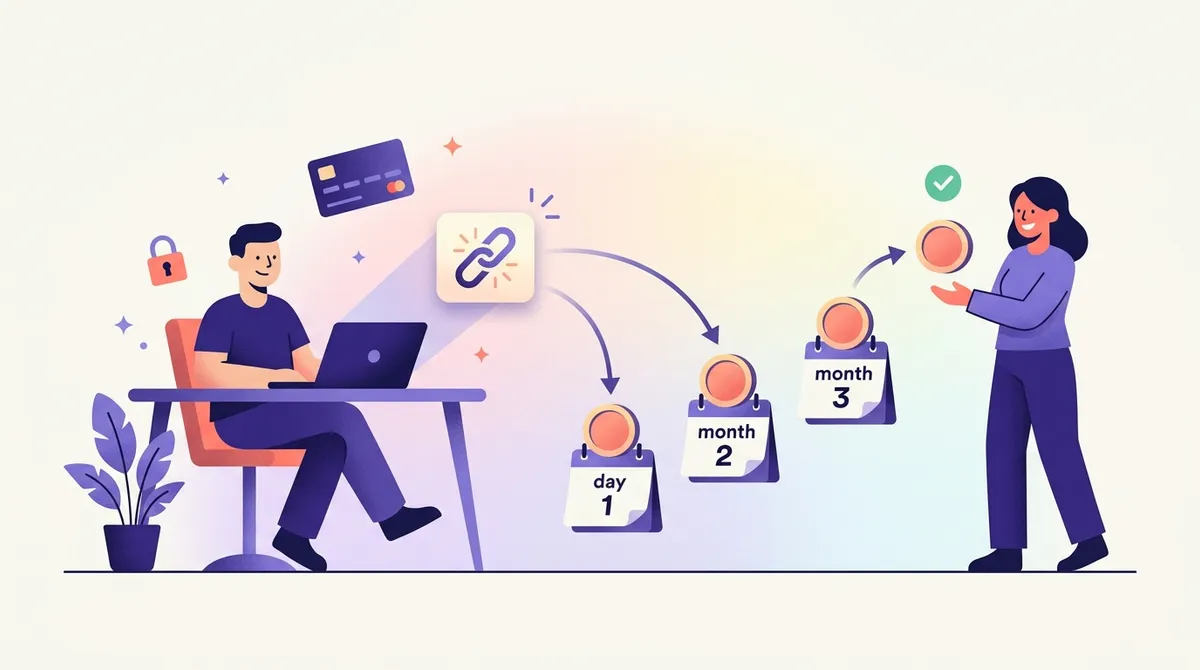
With this payment link, you spread your own payment. You set the price, the number of installments and the frequency. Your customer pays the first installment, then is charged automatically on the scheduled dates. Once the last installment is paid, the charges stop. With each charge, the funds arrive in your Stripe account. Depending on the payment methods enabled on your Stripe account, your customers can pay by card or by SEPA Direct Debit. There is no lender involved and no application for the customer to get approved.
Comparison of the three solutions
| Criterion | Deposit and manual payments | Split payment (PayPal Pay in 4, Alma, Klarna) | Stripy payment link |
|---|---|---|---|
| When you receive the money | With each transfer received | In full when the order is placed | With each charge |
| Installment tracking | Manual (spreadsheet, reminders) | Handled by the provider | Automatic, from a dashboard |
| Fees | None | Extra fees for the seller | Stripe fees and Stripy plan |
| Provider approval | None | Yes, the customer can be declined | No credit application |
| Who sets the terms | You | The provider (amounts, durations) | You (price, number of installments, frequency) |
When Stripy isn’t the right choice: if you need the full amount straight away (for example to cover costs before the service), a split payment solution will suit you better, since you are paid in one go. And if your service is short, a deposit followed by a final payment may be enough.
Setting up installment payments with Stripy, step by step
Stripy relies on Stripe to handle payments securely. No technical skills are needed and there’s nothing to integrate into your website: you connect your Stripe account, create a link and share it. (To understand what Stripe does and doesn’t offer natively, see our guide to installment payments with Stripe.)
Here is the video “Create your first installment payment link on Stripy” (in French):
Connect your Stripe account
If you already have a Stripe account, you connect it to Stripy in a few clicks. If not, you can create one along the way by entering some information about your business. Once this information is approved, your account is automatically linked to Stripy and you can create your first links.
Create your payment link
You enter a title, a description, a price and the number of installments (2, 4, 6, 10 or more), then the frequency: weekly or monthly. Options let you go further:
- have your terms and conditions accepted before payment (the right place to restate your payment schedule);
- redirect the customer to a page of your choice after payment;
- customize the confirmation email;
- collect additional information: company, SIRET number, phone, address.
Take an example: a coach sells a 3-month program for €900. They create a link with 3 monthly installments: the client pays €300 when signing up, then €300 each month for two months.
Share the link and track payments
You can share the link by email, by message, on WhatsApp or directly on your website. Your customer is redirected to a secure online payment page. The same link can be reused: it can serve several customers for the same offer.
As soon as an installment is paid, you receive an email notification. From your dashboard, you track the status of each payment schedule in real time: what has been paid, what remains to be collected, the schedule of upcoming charges and the customer’s details. You can also add notes. Once all the installments have been paid, the charges stop automatically.
What if a charge fails?
An installment can fail: insufficient funds, expired card, limit reached. Stripe then automatically retries the charge at several different times, which often resolves the situation on its own. If the problem persists, Stripy generates two links: one lets the customer update their payment method, the other lets them pay the installment directly.
Frequently asked questions about installment payments for micro-entrepreneurs
Can a micro-entrepreneur get paid in installments?
Yes. Nothing prevents a micro-entrepreneur from splitting the payment for a service: you can ask for a deposit, offer a payment schedule or use an automated payment link. Write the terms into your quote, contract or terms and conditions.
Do I need an invoice for each installment?
With a business client, an invoice is mandatory. Official guidance does not cover installment payments in detail; the safest approach is to issue one invoice per installment, referring to the quote. With an individual, a receipt is mandatory from €25 including VAT for a service. If in doubt, ask your accountant.
What is the maximum payment period?
Between businesses: 30 days by default, and at most 60 days from the invoice date (or 45 days end of month). With an individual, the law sets no deadline: your terms and conditions or your invoice set the terms.
What happens if the customer misses an installment?
With Stripy, Stripe automatically retries the charge, then two links let the customer update their card or pay the installment. If the payment is still outstanding, your terms and conditions should set out the consequences (suspension of the service, late payment penalties). With a business client, the €40 fixed recovery fee per unpaid invoice can apply if it appears in your terms and conditions or on the invoice.
Do I receive the full amount upfront?
No. At each installment, your customer is charged and you receive only the amount of that charge. If you need the full amount immediately, a split payment solution such as PayPal Pay in 4 or Alma pays you in full when the order is placed, in exchange for higher fees.
How is this different from PayPal Pay in 4 or Alma?
PayPal Pay in 4, Alma and Klarna are split payment solutions: a provider finances the purchase, pays you straight away and earns its money through fees, but it can decline a customer. With a Stripy payment link, you spread your own payment, on your own terms, with no credit application.
Is an installment payment a loan?
In principle, no. When you spread the payment for your own service yourself, at no cost to your customer, no lender is involved: it is a payment schedule. The consumer credit rules being tightened in France on 20 November 2026 target lenders, that is, split payment providers that advance the money. The official sources consulted do not cover this specific case: for your situation, ask your accountant or a lawyer.